
Transit-Level Base Verification
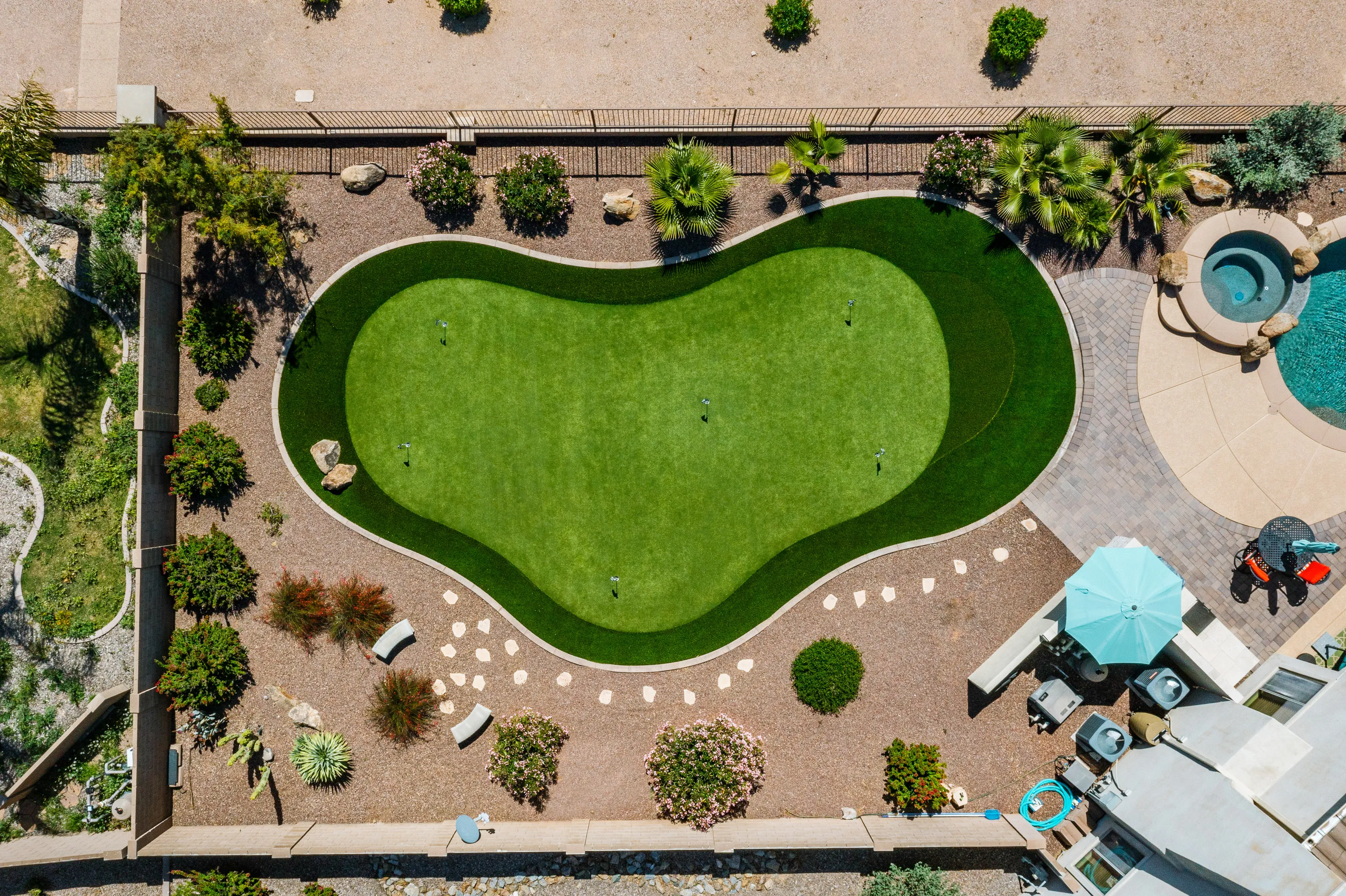
Base contour is verified against the design plan at five or more measurement points before surface installation begins—deviations at this stage cannot be corrected after the turf is down.
Service Detail
Backyard putting greens in Carrollton require precision base contouring and fiber selection that residential lawn turf installation does not. Turf Installation of Carrollton designs putting surfaces for consistent ball roll, functional drainage, and durability through North Texas thermal cycling—from February frost through August heat.
Overview
Backyard putting greens in Carrollton require precision base contouring and fiber selection that residential lawn turf installation does not. Turf Installation of Carrollton designs putting surfaces for consistent ball roll, functional drainage, and durability through North Texas thermal cycling—from February frost through August heat.
The base for a putting green is not the same engineering problem as a lawn base. A lawn can tolerate minor surface irregularity that reads as settled grade. A putting surface cannot—any deviation from the design contour produces a dead spot or an unintended break that makes the surface unplayable at the affected location. We crown the base from a designed high point outward to the perimeter drainage slope, verify the crown geometry with transit-level measurements at a minimum of five points, and do not proceed to surface installation until the base matches the design plan.
Fiber selection matters for putting green longevity in North Texas. Polyethylene fiber loses pile memory under sustained heat and foot compression faster than nylon-blend putting surface material. In a Carrollton backyard that sees 100-degree surface temperatures from June through September, a PE putting surface begins to show directional pile matting at the primary putting paths within two to three seasons—inconsistent ball roll that degrades the surface's value as a practice tool. Nylon-blend fiber holds its geometric properties through thermal cycling and returns to upright after foot compression more consistently.
Contour design for a Carrollton backyard putting green is calibrated to the homeowner's stated use intent: a flatter, simpler surface for recreational use and family entertainment, or a more aggressively contoured multi-break layout for dedicated practice. In either case, the drainage design doubles as the playability design—the base contour that moves water off the surface is the same base contour that creates the green's break angles. We document both the drainage gradient and the playability intent in a written plan before base work begins.
Where This Work Delivers Value
Scope is tailored to property layout, usage, and existing site conditions.
Base contour is verified against the design plan at five or more measurement points before surface installation begins—deviations at this stage cannot be corrected after the turf is down.
Nylon-blend putting surface material holds pile memory through North Texas summer thermal cycling better than polyethylene, producing consistent ball roll at the end of year three and beyond.
The base contour that drains the surface is also the contour that produces the putting breaks—we document both functions in a single design plan so the intended playability is recorded.
Benefits
What you gain from a well-planned installation.
Nylon pile that returns to upright after foot compression produces predictable roll regardless of which direction the previous putt traveled across the surface.
A properly drained putting surface clears after rain events and is usable the following morning—no waiting for soft ground to firm up as with natural grass practice areas.
Contour design specific to your practice goals—simple for recreational use, complex for serious skill development—rather than a generic green layout applied without regard to how you intend to use it.
Process
How we move from planning through final walkthrough.
We produce a scale drawing of the available space with pin positions, crown heights, and break angles documented before any base work begins.
Excavation, geotextile fabric, and aggregate installation at design depth. Base crown is built and verified with transit-level measurements—not estimated by eye.
Nylon-blend material is cut, seamed with adhesive appropriate to the location, and secured at the perimeter. Pin cups are set flush to the finished surface—off by 1/8 inch in either direction and ball behavior changes at the cup approach.
We conduct ball roll tests across the primary putting paths and a timed water application to verify drainage before closeout. Any surface inconsistency is corrected before we consider the installation complete.
FAQ
Common questions about this service.
For recreational and family-use putting greens, we typically specify 1/2-inch pile height, which produces a moderate stimp reading appropriate for players of varied skill levels. For dedicated practice greens aimed at replicating a club course surface, 3/8-inch pile produces a faster, more demanding surface. We discuss the target speed range during the design phase.
Fringe is installed with a thicker pile product—simulating a fairway or collar surface—cut to blend at the putting green perimeter seam. It requires its own drainage design and edge treatment to read correctly at the visual transition line. We include fringe in the design plan when the homeowner wants the full visual presentation of a proper putting green.
Turf products do not warp with heat. The concern is pile memory under high-temperature compression—which is the reason we specify nylon-blend over PE for putting surfaces in North Texas. The backing and adhesive system are also specified for the thermal cycling range typical of a Carrollton summer, so expansion at the seam lines does not create visible gaps.
Related
Explore other turf services we offer.
Coverage
This service is available across Carrollton and neighboring locations.
Share property details and we will follow up with planning options.
Submit project details and we will reach out with next steps.